


As development pushes farther into North Texas, lower land prices are getting attention. But the right site involves more than available acreage.
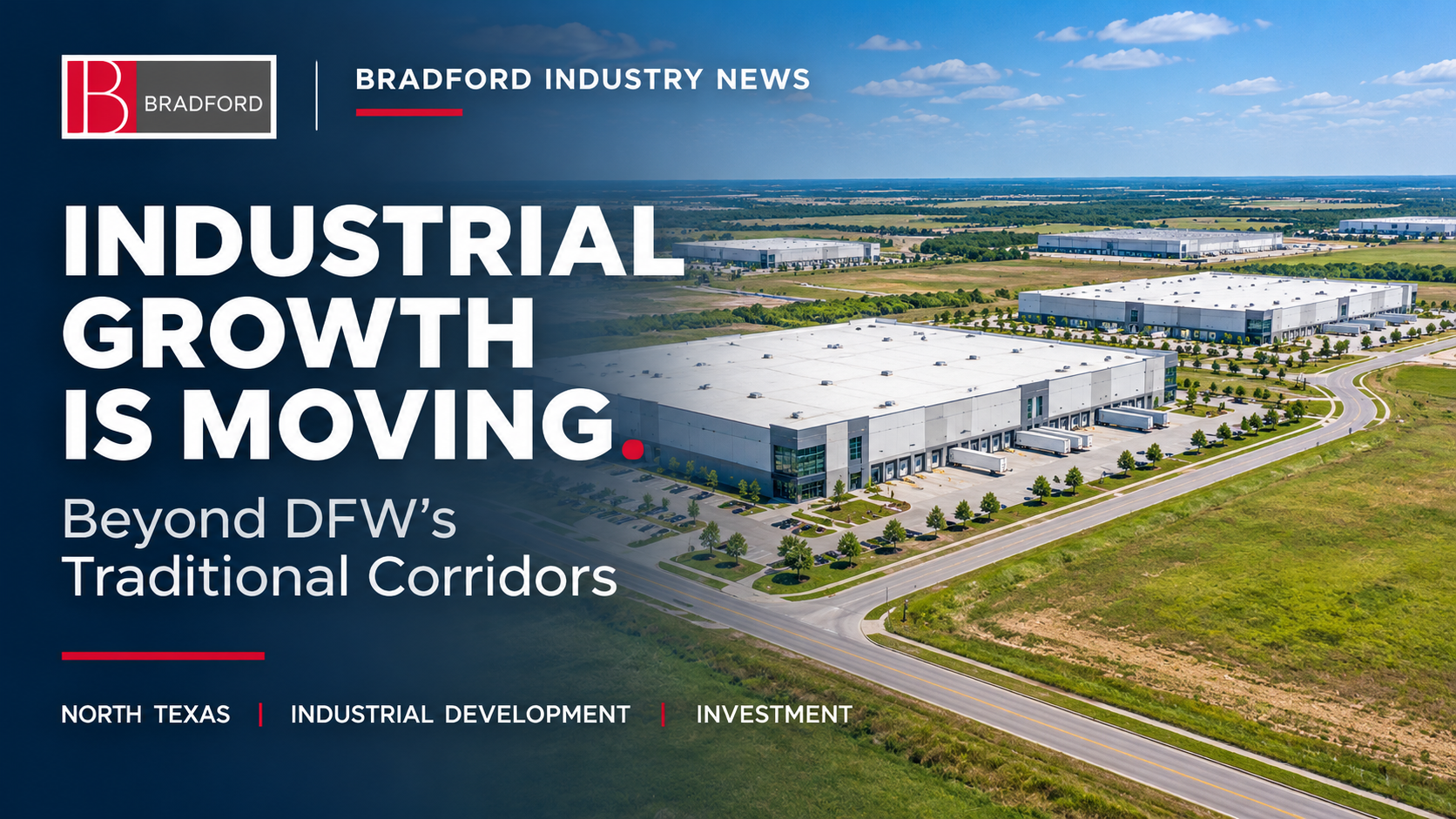
DFW industrial growth is expanding beyond the Dallas-Fort Worth Metroplex’s established industrial corridors. AllianceTexas, the DFW Airport area and South Dallas have long attracted distribution and manufacturing users. Now, developers are exploring new opportunities for North Texas industrial development outside these traditional locations.
At Bisnow’s November DFW Industrial Summit, industry leaders highlighted emerging opportunities in Grayson County, Denton and communities south, east and west of the Metroplex. As infill sites become increasingly scarce or expensive, investors are looking toward emerging markets for DFW industrial real estate opportunities. However, lower land prices do not automatically translate into better investments.
According to Colliers’ third-quarter 2026 DFW industrial report, the market recorded nearly 15.4 million square feet of positive net absorption. Vacancy fell to 7.9%, and roughly 40.3 million square feet was under construction. Those are strong regional numbers, but they do not tell an owner what will lease in any particular location.
Alliance, for example, benefits from an established transportation network, workforce access and a deep industrial tenant base. A site in a newer corridor may have a lower land basis, but it may also need more work—and more time—before a tenant can operate there.
In its November 18 coverage of the summit, Bisnow reported that Holt Lunsford Commercial’s Hutton Lunsford identified Grayson County as a possible future industrial corridor. Major semiconductor investments around Sherman are drawing interest from companies that support manufacturing operations. Developers also discussed opportunities in and around Denton, Midlothian, Weatherford, Forney and Terrell.
That does not mean every community will become the next AllianceTexas. Demand varies by user type. A supplier serving a manufacturing plant has different location needs from a regional distributor or contractor. Before buying land, owners need to know which businesses are realistic prospects and what they can pay.
A lower price per acre can disappear quickly when a development budget starts taking shape. Road access, grading, drainage, utility extensions, power capacity, permitting and construction timing all affect the final cost. For some operations, access to labor or customers matters as much as access to a highway.
The same is true for tenants. A lower rental rate farther from the core may not help if it adds transportation expense, longer trips between job sites or difficulty hiring and retaining employees. The right comparison is total occupancy and operating cost, not just rent or land price.
Not every industrial requirement calls for a massive warehouse. Contractors, service companies, equipment operators and regional distributors may need a smaller building, truck access and usable outdoor space. Some will consider locations outside the established corridors when the property fits their day-to-day work.
That makes the details important: loading, circulation, surface conditions, security and permitted uses. A property can be attractively priced and still be wrong for the business expected to occupy it. For industrial outdoor storage in particular, usable yard area and local restrictions deserve as much attention as enclosed building square footage.
There is opportunity beyond DFW’s established industrial corridors, but it is not a one-size-fits-all story. Owners considering land acquisition or redevelopment should test construction costs against realistic rents and tenant demand. Users should compare operational costs across locations before choosing a site.
At Bradford Commercial Real Estate Services, our Leasing & Brokerage team works with industrial owners, investors and tenants across the Metroplex. The right decision starts with understanding who will use a property, what it will take to make it functional and whether the economics hold up.
Before you buy, develop, lease or reposition industrial property, talk with Bradford. We can help you evaluate competing locations, site requirements, market rents, leasing assumptions and the costs that can change a deal.
Don’t make a major real estate decision on land prices or headlines alone. Contact Bradford’s team to discuss your property or space requirements.
Bisnow Dallas–Fort Worth, November 18, 2026 — DFW Industrial Growth Expands Beyond Core Markets
Colliers, October 28, 2026 — DFW Industrial Market Report | Q3 2026